As the mud-season of spring finally rolls into the Nutmeg State, most of us are eager to pack away the snow shovels and forget about our fireplaces until the first frost of September. We’ve said our “Winter Byes,” turned off the thermostats, and shifted our focus to lawn care.
But there is a silent sentinel standing on top of your house that just spent the last five months in a brutal war with the elements. Your chimney.
In Connecticut, our weather is uniquely destructive. We don’t just get “cold”; we get the dreaded freeze-thaw cycle—where temperatures dance around 32°F, forcing moisture into masonry only to freeze and expand it hours later. If you’ve noticed a new crack in your masonry or a mysterious drip in your firebox, it’s time to talk about the “hat” on your house.
In this guide, we’re breaking down everything from Concrete Chimney Cap Replacement Cost to why a Stainless Steel Chimney Cap is the best investment you’ll make this year.
1. The Great Confusion: Is it a “Cap” or a “Crown”?
Before we talk dollars and cents, we need to clear up the industry’s biggest terminology mix-up. If you’ve been looking for “How much to replace chimney cap,” you might be searching two very different things.
The Chimney Cap (The Metal Umbrella)
The Chimney Cap is the metal device that sits over the open hole of your flue. Its primary jobs are to keep rain out, keep sparks in, and act as a “no-vacancy” sign for Connecticut’s adventurous squirrels and birds.
The Chimney Crown (The Concrete Slab)
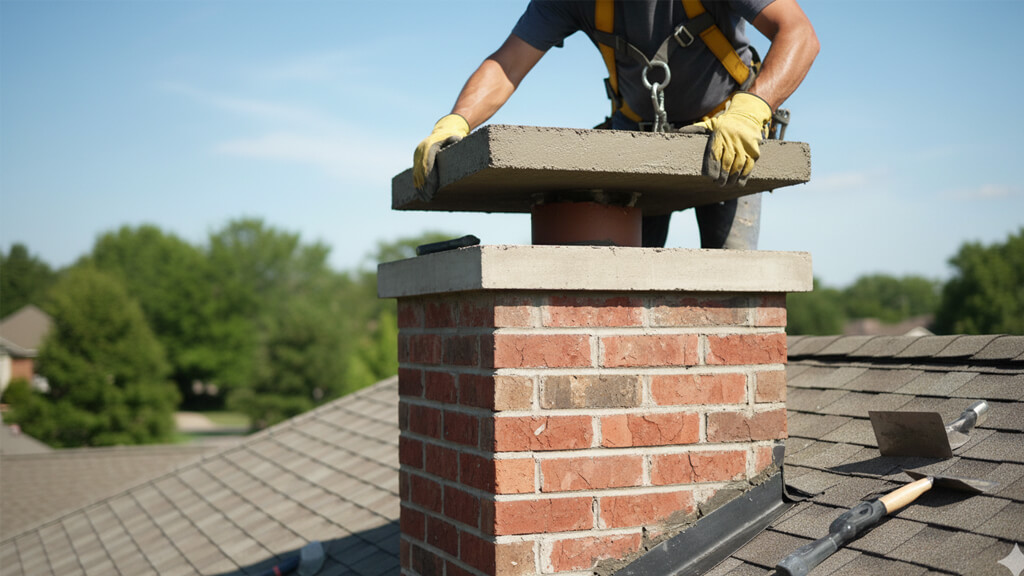
A Chimney Crown (often searched for as a Concrete Chimney Cap) is the large masonry floor that covers the entire top of your brick chimney. It’s sloped to shed water away from the structure. When this cracks, your entire chimney starts to rot from the top down.
2. Deep Dive: Concrete Chimney Cap (Crown) Replacement Cost
If your chimney is leaking, the crown is the most likely culprit. In Connecticut, we see a high volume of calls for this because the traditional mortar used by builders in the 80s and 90s wasn’t designed for 2026 weather patterns.
What are you paying for?
Concrete Chimney Cap Replacement Cost: Most homeowners in Connecticut end up spending somewhere between $1,800 and $3,000 for a full crown rebuild, depending on access and damage.
Why is it so much higher than a simple metal cap?
- Labor at Height: We aren’t just slapping on a part; we are performing masonry work 30 feet in the air.
- Material Quality: A proper crown is made of reinforced, fiber-infused concrete, not just leftover mortar.
- The Drip Edge: A professional replacement includes a “drip edge” that hangs over the side of the brick, ensuring water falls to the roof rather than running down your chimney’s face.
If you catch cracks early, a professional sealant (like CrownSeal) can be applied for $400 – $800, effectively “resetting” the life of your crown for another 10–15 years.
3. The Armor: Chimney Cap Installation Cost & Materials
If your crown is the “roof” of your chimney, the cap is the “front door.” Every chimney in Connecticut should have one, yet we still see hundreds of homes with open flues.
Chimney Cap Installation Cost breakdown:
Across the CT market, a professional installation typically ranges from $190 to $650.
- Standard Single-Flue: $200 – $350
- Multi-Flue (covering 2 or 3 holes): $400 – $900
- Custom / Copper: $1,000+
Why we insist on Stainless Steel
When looking at Cost of Stainless Steel Chimney Cap (which usually sits between $250 and $600 installed), some homeowners ask about the cheaper galvanized steel versions.
Here is my professional advice for CT residents: Avoid galvanized steel. Within 3 to 5 years, the salt air and heavy moisture in our region will cause galvanized caps to rust. That rust then bleeds down your chimney, leaving permanent orange streaks on your beautiful brick or siding. Stainless steel is a “one-and-done” purchase that comes with a lifetime warranty.
4. The Prefab Problem: Chase Cover Replacement Cost
Not every chimney in Hartford County is made of brick. Many modern homes use “factory-built” chimneys—a metal pipe surrounded by a wood-framed “chase” covered in siding.
Instead of a concrete crown, these have a metal “lid” called a Chase Cover.
If you hear a rhythmic “tink… tink… tink” sound inside your fireplace during a rainstorm, your chase cover has likely rusted through.
- Cost to Replace Chimney Chase Cover: Expect to pay between $400 and $1,500.
- The Danger Zone: A rusted chase cover allows water to run down the inside of your walls. By the time you see a leak in your living room, the wooden studs inside the chimney chase may already be rotting.
5. “How Much To Install Chimney Cap?” (The DIY vs. Pro Debate)
You might see a cap at a big-box hardware store for $60 and think, “I can do that.” We love the DIY spirit in Connecticut, but here is what the pros at GMT Home Services bring to you:
- The Flue Fit: We don’t just “guess” the size. We measure for proper airflow (draft). If a cap is too small, your fireplace will smoke you out of the house.
- Safety First: Most chimney work requires 32-foot extension ladders and roof harnesses. One slip on a slate roof can be life-changing.
- Warranty Protection: When we install a Stainless Steel Chimney Cap, the warranty is backed by our professional certification. If it blows off in a Nor’easter, we’re the ones who come back to fix it—not you.
6. Real Homeowner Inquiry: “Is Spring Really the Best Time?”
Most people think of chimney sweeps as a “fall activity.” But waiting until October is a gamble.
The “Winter Bye” Effect: During the winter, your chimney has been expanding and contracting. As the snow melts in March and April, that water finds the new cracks. If you address Chimney Crown Replacement Cost in the spring, you are sealing the house before the heavy spring rains start.
Additionally, spring is nesting season. In Connecticut, we have “Chimney Swifts”—federally protected birds that love to live in open flues. If they move in, it is illegal to remove them until they leave in the late summer. A Chimney Cap Installation in April prevents a 4-month bird infestation.
7. Expertise You Can Trust: Why Credentials Matter
When you are researching the Concrete Chimney Cap Replacement Cost or looking for a specialist to handle a complex Chase Cover Replacement, you aren’t just buying a piece of metal or a bag of concrete. You are investing in the structural integrity of your home.
In the chimney industry, experience is the only true teacher. Over 12 years of dedicated field experience with architectural challenges of Connecticut homes—from historic 1920s Tudors to modern colonials— has taught us that the weather doesn’t discriminate, but architecture does. We’ve identified the recurring failure points unique to our region, allowing us to provide solutions that don’t just ‘fix’ the leak, but prevent the next one.
“In West Hartford’s 1920s Tudors, we often find original lead-coated copper flashings that have finally reached their limit after a century. Meanwhile, the modern colonials in New Britain frequently struggle with undersized ‘builder-grade’ chase covers that weren’t designed for the wind-driven rain we’ve seen in recent years. We don’t just see a chimney; we see the specific history of the masonry and the likely failure points before we even set up the ladder.”
CSIA Certified Professionalism
We don’t believe in “guesswork.” Our team maintains industry certifications, ensuring that every Chimney Cap Installation or masonry reconstruction meets the highest safety standards and local CT building codes. When we stand on your roof, we bring a decade-plus of technical knowledge regarding:
- NFPA 211 Standards: The national benchmark for chimneys, fireplaces, and vents.
- Advanced Masonry Techniques: Ensuring your new crown survives another 12+ Connecticut winters.
- Precision Flue Sizing: Calculating the exact draft requirements so your home remains smoke-free.
Summary Checklist for the CT Homeowner
As we transition out of the winter months, use this professional “cheat sheet” to audit your chimney’s health:
- The Crown Audit: Look for “efflorescence” (a white, salty powder) on your exterior bricks. This is a red flag that your concrete crown is porous and leaking.
- The Cap Audit: If you can see a dark, open hole at the top of your chimney from the driveway, you are missing a cap. This is an open invitation for rain and chimney swifts.
- The Chase Audit: For prefab chimneys, check the metal “lid.” If it is flat and holding standing water, it is a ticking time bomb for rust.
2026 Price Snapshot at a Glance:
- How Much To Install Chimney Cap? (Professional Labor + Part): $300 average.
- Stainless Steel Chimney Cap Cost? (Lifetime Material): $250 – $600.
- Concrete Chimney Cap Replacement Cost? (Full Masonry Rebuild): $2,500 average.
“Actual costs can vary based on chimney height, roof access, and the extent of damage.”
Final Thoughts: Protecting Your Investment
Taking care of your chimney after winter is a practical step, not an optional one. Small issues like cracks in the crown or a missing cap can quickly lead to water damage, interior leaks, and costly structural repairs if ignored. Addressing these problems early keeps maintenance straightforward and prevents unnecessary expenses later.
If you’re not sure about the condition of your chimney, a professional inspection can give you a clear picture of what’s going on and what actually needs attention—nothing more, nothing less. That way, you can make informed decisions based on facts, not guesswork.