
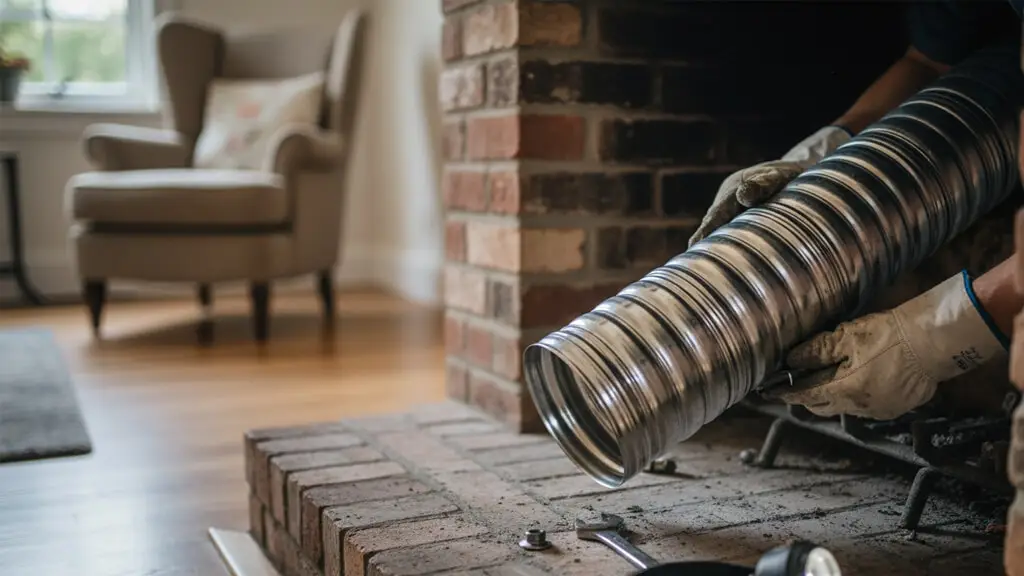
If you’ve been told your chimney is “unlined” or your current flue tile is cracked, you aren’t just looking for a pipe—you’re looking for fire safety. At GMT Home Services, we believe a transparent fireplace liner replacement cost breakdown is the first step toward a safer home.
In this guide, we’ll dive into the technical specs, the labor variables, and the real-world pricing for chimney relining in 2026.
Why Does a Chimney Liner Cost So Much?
Many homeowners ask, “How much should a chimney liner cost?” thinking it’s just a DIY hardware store trip. In reality, a professional chimney liner installation cost covers three critical technical pillars:
- Code Compliance (NFPA 211): National fire standards require a liner to be gas-tight and capable of containing products of combustion.
- Corrosion Resistance: Using the wrong alloy for your fuel type (oil, gas, or wood) will lead to liner failure in under five years.
- Thermal Protection: Professional lining includes UL 1777-listed insulation, which prevents heat transfer to your home’s wooden framing (a process called pyrolysis).
2026 Price Guide: Chimney Relining Cost Breakdown
The price for chimney liner install varies based on the material used and the height of your home. Most residential chimneys in our area are 20–35 feet tall.
| Liner Type | Avg. Material Cost (Per Foot) | Total Installed Cost (Avg) | Best Use Case |
| Aluminum | $15 – $25 | $900 – $1,800 | Low-efficiency Gas only |
| 316L Stainless Steel | $40 – $75 | $2,500 – $5,500 | Wood, Oil, Coal (The Standard) |
| Titanium-Stabilized | $60 – $90 | $4,500 – $7,500 | High-heat wood stoves |
| Thermocrete | N/A (Liquid) | $5,000 – $10,000+ | Historical restoration |
Note: Chimney liner cost per foot typically decreases as the total length increases due to fixed labor setup costs.
Technical Expertise: Why GMT Home Services is Different
When analyzing the cost of fireplace liner options, the “cheapest” bid often skips the technical details that keep your family safe.
Alloy Matching: 304 vs. 316L Stainless Steel
We don’t just “drop a pipe.” We match the metallurgy to your appliance.
- 316L Grade: This is our standard for wood and oil. It contains molybdenum for increased corrosion resistance against acidic soot.
- AL 29-4C: Specifically used for high-efficiency gas furnaces where condensation is highly corrosive.
The “Zero-Clearance” Insulation Standard
A new chimney liner cost at GMT includes high-density ceramic wool insulation. This ensures your chimney hits the “1-inch clearance to combustibles” safety rating. Without this, a chimney fire can easily spread to the 2×4 studs behind your drywall.
The Heart of the Choice: Should You Patch or Protect?
When you discover a crack in your chimney, it’s rarely just about the masonry; it’s about the peace of mind you feel when you tuck your family in at night while a fire crackles downstairs.
When a Repair is the Right Path
If your chimney is relatively young and a video inspection reveals only localized issues—like a single cracked flue tile—a professional repair is a responsible choice. Techniques like HeatShield® Cerfractory Flue Repair can resurface your existing clay tiles, sealing those dangerous gaps without the need for a full demolition. This is the “surgical” approach: we fix what is broken and save you thousands.
When Replacement is an Act of Stewardship
If your liner has survived a chimney fire, shows widespread “spalling” (flaking), or was built before modern safety codes, a full relining is the only way to truly protect your home’s legacy. Think of a new stainless steel liner as a “lifetime shield.” It’s an investment that says you’re done with temporary fixes and ready for permanent safety.
The Reality of “Invisible” Deterioration
In the home services industry, we often say that a chimney dies from the inside out. While your exterior brickwork may look solid, the internal flue tiles are subjected to a brutal cycle of extreme heat and freezing Connecticut temperatures.
This causes thermal shock, resulting in “spalling”—where the clay face of your liner literally flakes off, falling to the base of the chimney and creating dangerous blockages. When this happens, the fireplace liner replacement cost is no longer just a home improvement expense; it is a critical intervention.
A cracked or shaled liner allows heat to transfer directly to your home’s internal wooden framing, a process that can lead to a structure fire without a single puff of smoke ever entering your living room. Choosing to reline with a UL-1777 insulated stainless steel system isn’t about buying a “pipe”; it’s about restoring the structural integrity and fire-containment capability of your home.
Why the “Cheapest Bid” Often Breaks Your Heart
A low-ball quote usually means a technician is skipping the technical essentials:
- They skip the insulation, leaving your home vulnerable to heat transfer.
- They use inferior alloys, which will corrode in just a few years.
- They ignore NFPA 211 standards, leaving you with a system that isn’t legally “to code.”
At GMT Home Services, we don’t want to be your cheapest option; we want to be your last option.
Conclusion: Prioritizing Long-Term Structural Safety
Ultimately, the cost of replacing a fireplace liner is an investment in the structural integrity of your home. While the upfront price of a professional, insulated stainless steel system may be higher than a simple “drop-in” pipe, it addresses the fundamental physics of heat transfer and corrosive byproduct containment.
Choosing a solution based on code compliance and thermal protection ensures that the chimney remains a safe exhaust for the life of the home, rather than a hidden fire hazard behind the masonry.
FAQ: Maximizing Your Chimney Liner Knowledge
Q: How much does it cost to reline a fireplace for wood burning?
For a standard wood fireplace, the cost to reline a fireplace with a 6-inch or 8-inch stainless steel heavy-wall liner typically ranges from $3,000 to $5,200. This includes a top plate, rain cap, and professional insulation.
Q: Is a clay chimney liner cost lower than stainless steel?
While clay chimney liner cost for materials is lower, the labor is significantly higher. Replacing clay tiles requires breaking out the old masonry, which can drive the chimney installation cost well over $7,000.
Q: How much to install a chimney liner for a gas furnace?
Because gas furnace liners (often called chimney sleeves) are smaller in diameter, the cost of lining a chimney for gas is usually lower, ranging from $1,200 to $2,500.
Q: How much does a chimney liner cost if I have a very tall chimney?
When calculating chimney liner cost per foot, expect to pay between $40 and $80 per foot for the material and labor. For a three-story home, the price for chimney liner install will naturally sit at the higher end of the average range.
Q: What is the cost of fireplace liner if I choose Thermocrete?
Thermocrete chimney lining cost is typically higher, starting at $5,000. It is a specialized ceramic coating sprayed inside the flue, often used in historic homes where a stainless steel pipe won’t fit.
Q: How much should a chimney liner cost for an oil-to-gas conversion?
If you are switching fuels, you must reline. The cost of fireplace liner for this transition is usually around $2,000 to $3,500, ensuring the new gases don’t destroy your old masonry.